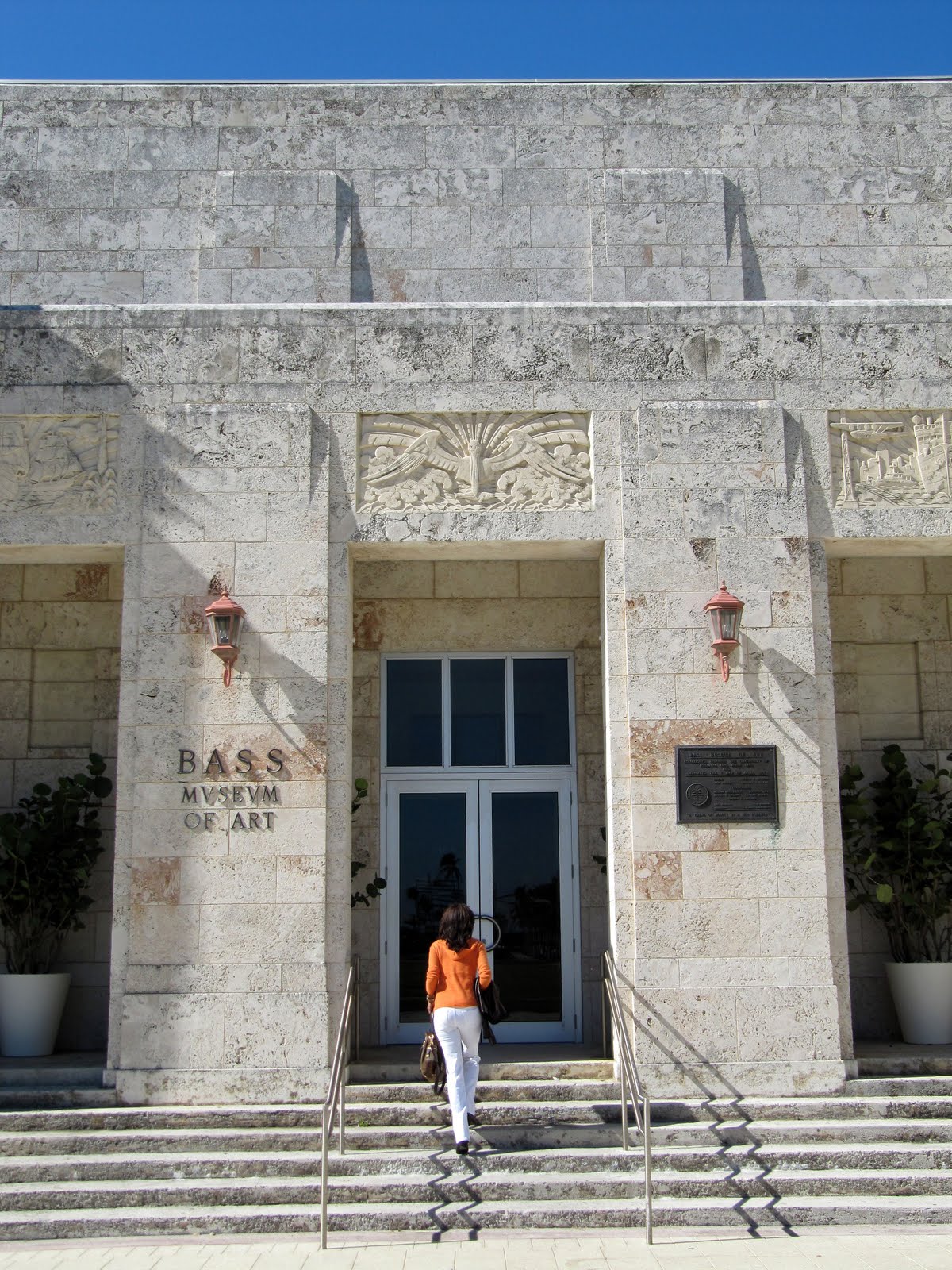
Miami Beach’s Bass Museum of Art has seen some great improvements, in addition to hosting an imposing exhibition of the work of Isaac Julien.The original building was completed in 1930 as the John Collins Memorial Library and ArtCenter (Russell Pancoast was the architect) and terminated an ocean-facing axis within CollinsPark.In 1962, a new library building was constructed between the original and the ocean, blocking this axis.More importantly, the view from Collins Avenue, the main access to the building, was blocked as well.
This began a decades-long front-back crisis for the building.After the library moved, the building was rededicated as the Bass Museum of Art in 1964.But where was its entrance?Facing the back of the new library?Facing Park Avenue, a minor street?In 2000, an addition (designed by Arata Isozaki with Spillis Candela DMJM) attempted to make Park Avenue the main entrance.This entance treatment still did not feel right, since it was small and obscured from the street.
Shortly thereafter, a third library building was constructed next to the park and the axis-blocking second library was demolished. As of this week, just in time for Art Basel Miami Beach, the main entrance for the BassMuseum has been restored to the Collins Avenue side.I was initially worried that the building wouldn’t be able to hold the axis, that it was simply too small.
Seen from Collins Avenue (see second photo from the top), the Bass Museum is large enough to be a pleasant, not overpowering, surprise.There is enough mass to draw the curious pedestrian from his or her path to see the building up close.The bas reliefs and other sculptures surrounding the entrance (by Gustav Bohland) are particular treats (see top, fourth, fifth, and sixth photos).Viewed from the ocean, the BassMuseum is easy to miss (see third photo, with Art Basel installations in the foreground), but this latter vantage point is not as important as the one from the move trafficked Collins.
Coinciding with Art Basel, the BassMuseum has opened a new exhibition of the video and photographic work of Isaac Julien.This is the best art exhibit I have seen at the Bass Museum (http://www.bassmuseum.org/art/isaac-julien-the-creative-caribbean-network/).The short film “Baltimore” (2003) and the multi-screen “Ten Thousand Waves” (2010) are the most engaging parts of the exhibition.
The way the nine screens are arranged in “Ten Thousand Waves” make viewing the entire piece impossible.It is an ingenious way to underscore the complexity of what is being communicated, an interpretation of the lengthy history of the most populous country on Earth.
1111 Lincoln Road in Miami Beach is primarily, at least by square footage, a parking garage. In most instances, this would be a deadly addition to a commercial district. This building, completed this year, is astounding in many ways -- as a work of art, a destination, and as a sensitive part of the urban fabric.
The architectural office of Herzog & de Meuron designed this building as part of a larger project that includes the reuse of the adjacent mid-century modern SunTrust building (originally, Pioneer Bank, completed in 1971, with Ferendino, Grafton, and Pancoast as architects). The SunTrust has windows recessed behind vertically angled "brise soleil", concrete sun shades. This gives the building a very three-dimentional facade, especially for a modern building. It was my fear that the SunTrust would be demolished, given the general change in the area from office to residential and retail uses.
In beautiful contrast to my fear, 1111 Lincoln is a very good companion to its neighbor (see second photo from the top). There is continuity and variation, which is what is often true in good design and needed in an existing urban fabric. The buildings are of about the same volume and material (concrete). However, whereas the SunTrust is white in finish and has uniform floor heights and fenestration, 1111 Lincoln is made of "natural" (relatively unfinished) concrete and has widely varying floor heights and treatments.
1111 Lincoln is also a good host to passers-by. The ground level has retail uses, yes, but also has a feature that is too-little used. There is a projection of significant depth above the first floor that protects pedestrians from the sun and rain (see third photo).
The overhang is one of the features that give 1111 Lincoln a Rio de Janeiro feeling. Superficially, one of the retailers is Rio clothier Osklen and, probably because of its presence, Portuguese can be heard frequently on this block. More importantly, this block is the latest extension to the Lincoln Road mall (also designed by Herzog & de Meuron, with Raymond Jungles), with pedra portuguesa in a stripped-down, black and white Brazilian pattern as pavement (again, see third photo).
Inside, the twists of the facade continue, literally and figuratively. The primary pedestrian entry into the garage leads to a set of stairs, which, in turn, leads upward in helter skelter fashion (see fourth photo). Each floor seems to be a different height, with a different type of ramp design for the cars to get from one to the next level. Then, on the fifth level, in the midst of parking, is a commercial use (note the glass "box" on the left-hand side of the top photo). A fellow visitor also told me there is a rumor of a house having been perched on the roof.
The seventh floor, the top level of parking, has perhaps the best stress-free view in Miami (there are many good views in the city that can be had by posing as a hotel guest or other desirable visitor, but I don't like the pressure). We can all pretend to be looking for our cars when we come upon views of the city, ocean, and bay (see last photo of the view of Miami Beach, with the Port of Miami and downtown in the distance). The roof is supported by a V-shaped column and there is a V-shaped gap in the ceiling, revealing sky. Could all these crotches and "V"s be saying something (see fifth photo)?
1111 Lincoln Road is a great addition to a city rich in architecture. Its beautiful and dramatic spaces have already been used for at least one photo shoot. The seventh floor is currently hosting Intersection Magazine's show for Art Basel Miami Beach. The show is, not surprisingly, car-themed.
Miami Beach has been improving its streets. The city should be applauded and encouraged to do more. "Bulb outs", the narrowing of the roadway at intersections or mid-block, have been added to Alton Road (see bottom photo) and to Indian Creek Drive (see top photo) recently. This is done to reduce crossing distance for pedestrians and speed for motorists
Like most places in the United States, Miami Beach has streets that were designed to move as many motor vehicles as quickly as possible. In some instances, civil roads were remade to achieve this end. The result is a street network that often discourages walking, biking, and general sociability.
Further improvements could be made to Indian Creek and adjacent Collins Avenue. They were probably built as two-way streets. Two-way traffic should be reintroduced and the roadways narrowed. In addition to making these streets safer (because speeds will be reduced), it will also be easier for motorists to get to their destinations.
I would like to wish a happy Hannukah to all my Jewish family, friends, and readers. It is a highlight of my Art Basel Miami Beach trip to see the giant dreidel and menorah displayed on Lincoln Road. Is it kosher for these objects to be made of seashells? Whether or not, or especially if not, they are a Jewish/Florida synthesis that is joyous and humorous. The dreidel and menorah were made by Roger Abramson and the display is sponsored by the Chabad House of Miami Beach.
When I go to the beach, I troll for garbage. It is my way of claiming the beach, loving the beach, and, most importantly, seeing it. Looking for cigarettes is not my goal. Looking for cigarettes is the process I use to make me look at the sand, water, and sky. It is also a great excuse to walk around and see what people are up to.
Last summer, at Chicago's gayish Hollywood Beach, I used my trash collecting as a source of material to make collages that commemorated the days. It is a bit cyclical -- I went to the beach, found some cigarettes, and glued them into my journal as a memorial of looking for cigarettes. I generated some garbage of my own, the "Blue Bunny Sundae Crunch" wrapper and stick (see bottom photo). This treat reminds me of the strawberry shortcake bars I got as a kid from ice cream trucks on Chicago's South Side.
The top collage is a bit more complicated. I call it "Bicycle and Ladder go to the Beach". I bought an eight-foot ladder for a project and knew that if I took it home, I would not have enough desire to go back out to the beach. So, the ladder accompanied me (and the bicycle) to the beach.
I am very fond of cars with wreaths attached to their grills at Christmas. There is something both festive and hostile about it. A delicate, loving baby was born, and we mark that event by dressing up a potentially deadly machine.
In recent days I came upon two bits of garbage. The first was a short length of red ribbon. This made it to the handlebars of one of my bicycles.
A few days later, I found several feet of evergreen branches that were bound together, something that might have been used to wrap the lamp posts of a Chicago commercial district. It was sitting in the street as I rode by. I turned back and picked it up. It is now wrapped around the top tube of the bike, with the red ribbon securing an end to the handlebars.
The oven has not been working since I moved into my apartment this summer. I didn't like the range much -- It didn't look like a quality product and certainly was not cared for. Instead of repairing it or buying a new stove, I wanted to get an old stove, one from the 1940s, 50s, or 60s. I grew up with such a stove, which my grandmother, Milosava Petković, used to make many tasty meals. She was a great cook.
While I prefer old and used things to new ones, I can see their flaws. In a car, no matter how beautiful an old one may be, I would prefer a new one. They are (usually) safer. When it comes to gas stoves, however, there is no benefit to having a new one. The old ones are sturdy, have a clumsy grace, and they seem to burn bluer (see top photo).
The search for an old stove wasn't as easy as I thought it would be. When I lived in San Francisco, there were salvage yards and used appliance stores that carried stoves of this age. They were esteemed objects.
Chicago is a more difficult environment for old stoves. The few stores that carried decades-old stoves have closed. An appliance retailer, who appreciates the old, says that Chicagoans seem to prefer certain homogeneous looks (currently it is granite and stainless steel everything).
Fortunately, I asked a friend if he knew where I could find an old stove. He had recently bought a century-old worker's cottage in Chicago's Logan Square district. He told me that he had two stoves he no longer wanted (maybe he, too, was going for granite and stainless steel). In every case, Jonathan sold me a beautiful, (probably) 1950s, Cribben & Sexton Universal stove (see photo of it in the garage in Logan Square). It has an atomic-era logo that seems to promise that, if the stove cannot protect you from annihilation, at least it can cook as well as a nuclear bomb (see photo, second from the bottom).
Yesterday, the stove was loaded onto a truck, carried up three flights of stairs, and installed in my home. The flame burns bluer. A repairman is coming tomorrow. The oven doesn't work (and that's fine).


 country on Earth.


